
 Sarah Chicoine (CSU ’18, B.M., Music Education) starts each class at Munroe Elementary in Denver, Colorado, with an artist of the day. She talks with her students about musicians such as Harry Styles and his gender-fluid style, Lizzo and her body positivity, and Halsey, who is biracial but white passing. They study musicians whom the students love and are relevant to them, such as Celia Cruz, Shakira, Kendrick Lamar, Bruno Mars, and others.
Chicoine, who has been the music teacher at Munroe for six years, is not concerned about winning awards or performing at conferences. For her, authenticity comes from seeing the kids in her classroom develop a love and curiosity for music that continues for the rest of their lives.
Chicoine's students perform choral works for an ‘arts night’ at Munroe, a showcase of visual and performing arts that incorporate dance and music. Chicoine, who also holds a Master of Arts in Culturally and Linguistically Diverse Education from the University of Colorado Denver, incorporates culturally responsive repertoire with songs in Spanish and other languages.
For the upcoming concert, second- and third-grade students will perform “No School Tomorrow” by jay althouse, as well as “Jingle Jingle” and “Un Poco Loco” from the movie Coco. The fourth and fifth grade will perform “Puebla” by Alvaro Soler, “Vienna” by Billy Joel, and “Happy” by Pharrell Williams.
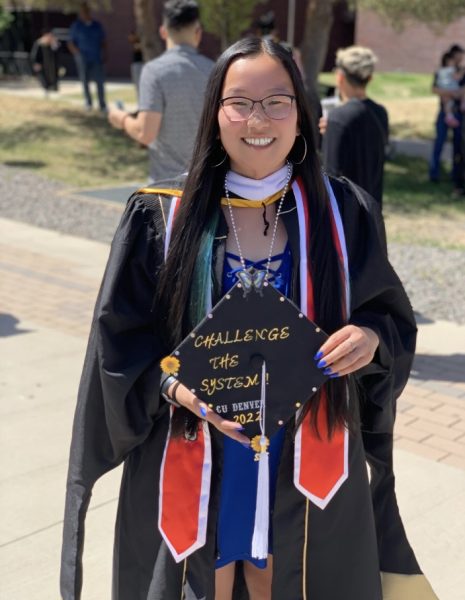
"I personally love working at Munroe because of the beautiful cultures and community we have here,” said Chicoine. “I believe in challenging systems of oppression and giving students opportunities they may not receive elsewhere due to different barriers that may hold them back.”
The music classroom is a safe space
Chicoine hopes her class is more than a place to make music – that it’s a safe space where students can build relationships and explore their own musical interests. She also hopes to continue seeing music educators connect with their students through different cultures, allowing their students to feel seen, loved, and heard.
“Really step into that uncomfortability if you have biases against or towards people of color or different ethnicities or backgrounds, and as you do, ask yourself, ‘Why am I feeling that way?’ I feel like that is something we constantly need to check ourselves on and digest,” she said.
In a profession where burnout is an issue, Chicoine advocates for prioritizing mental health and avoiding toxic positivity within the workplace. She knows that being a teacher requires wearing many hats and is honest about the emotional challenges she faces.
“If I am having a rough day, I will name that to my students,” says Chicoine. “I let them know I am not feeling my best, and I am going to do the best I can that day. Modeling is a vital strategy to use when teaching, and it goes beyond just the content. We need to lead by example and model what it's like to be vulnerable and real with students.”
Mentorship helps create balance
With multiple activities occurring each week, from teaching, lesson planning, and being formally observed and scored to meeting and collaborating with colleagues and providing mental health resources to students, Chicoine realizes the importance of setting boundaries to achieve a work-life balance. For her, this has also included mentorship.
One of the many influences in her musical upbringing was her high school choir teacher, Susan Kullman, who always picked repertoire that was engaging and culturally responsive. Coincidentally, they are now in the same school system, allowing them to collaborate and find inspiration from one another.
Chicoine feels fortunate to have had a place like CSU, where she received the education she needed while solidifying her passion for being a music educator. CSU also provided opportunities to explore outside interests, such as being an RA, nannying for a family, and community involvement.
The end of the school year brought another longstanding tradition: a performance by her fifth graders singing “Waving Flags,” where students held flags representing their different nationalities, sang the song in other languages, and played percussion. This tradition is a culmination of the pride and acceptance that Chicoine has nurtured within her classroom, her pedagogical skills at work, and the talent she has fostered.